

MULTISCALE MODELLING OF ENVIRONMENTAL AND FREE SURFACE FLOWS WITH PARTICLE-BASED METHODS
MOVEFREE
Proposal objectives and challenges
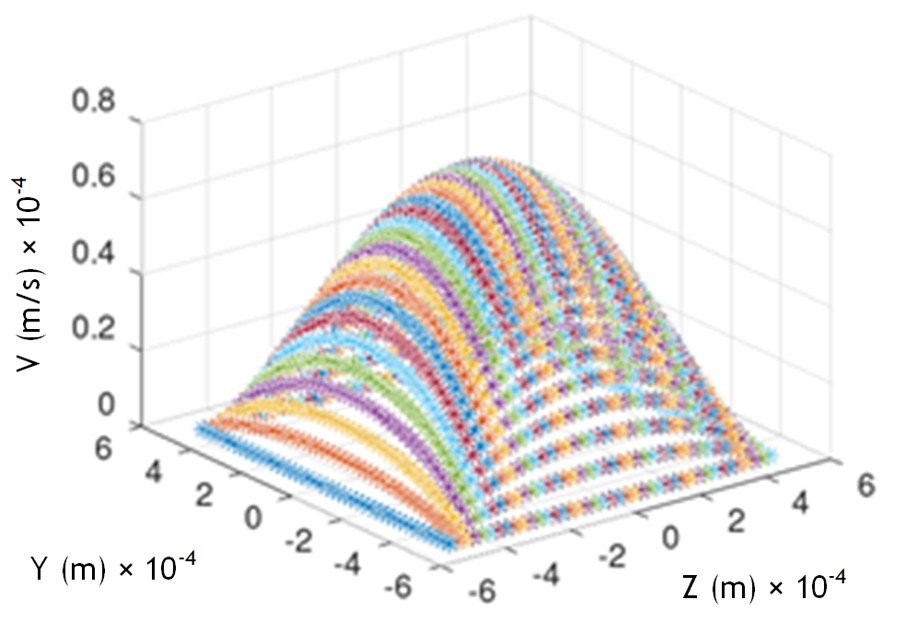
It is proposed to develop a unified framework for modeling and simulation of flows at the microscopic, mesoscopic and macroscopic level. Microscopic modeling and computation is performed in the framework of the well established Molecular Dynamics (MD) method. Mesoscopic modeling requires particle-based methods which include thermal fluctuations. In contradistinction, conventional Computational Fluid Dynamics (CFD) algorithms rely heavily on continuous Eulerian formulations for the macroscopic description of flows. It is proposed to develop reliable and efficient Lagrangian particle-based methods for the computation of macroscale flows so that the development of a unified framework based on mesh-free particle-based method across scales will be both conceptually and practically easier. We propose to focus on the method of Smoothed Dissipative Particle Dynamics (SDPD) for mesoscale problems and the method of Smoothed Particle Hydrodynamics (SPH) for the macro-scale. The overall strategy will be based on Lagrangian, mesh-free methods with a view to achieve multi-scale simulations coupling, at first, SDPD and SPH. A further integration step will include the nanoscale simulated with the well established Molecular Dynamics (MD) method.
Open questions
SPH was originally proposed as a method for the solution of problems in astrophysics since the collective movement of star-particles resembles the movement of a fluid and it can be modeled by the governing equations of Newtonian non-viscous compressible flow. For approximately 15 years the method was exclusively at the hands of astrophysicists. Monaghan (1994) proposed the application of SPH to simulation of free-surface flows. The original formulation assumed a weakly compressible fluid. Monaghan’s proposal kicked off a period of great interest in SPH which lead to significant improvements and extensions of the method. Currently, important research directions are the efforts to develop a truly Incompressible Smoothed Particle Hydrodynamics (ISPH), the work to develop SPH-based turbulence models, the CPU-GPU implementations of SPH and SDPD, and the efforts to develop algorithms for multi-phase flow. Despite those developments a number of open questions related to the application of SPH method to viscous incompressible flow problems, such as water flows, exist. In the proposed project we will address the following issues:
- On a fundamental level, the treatment of pressure can be carried out either through an equation of state or by enforcing the incompressibility condition via a Poisson equation for pressure. We intend to compare the two methods and furthermore, we plan to use an alternative formulation of the governing equation based on artificial compressibility.
- A more technical but equally important issue for many water flows is the treatment of viscosity, which is a key quantity in determining water transport. Till now, viscosity, either as a standalone computed property or via the diffusion coefficient calculation, is hard to obtain and is object to huge computational burden. Investigations are limited to simulations at the nanoscale, based mainly on Molecular Dynamics, and two methods are proposed; the Green-Kubo formalism and NEMD methods, which take into account the induced strain rates in a confined channel. Apart from the two aforementioned straightforward methods, a linking scheme that connects diffusion coefficient and shear viscosity can also be incorporated. Shear viscosity is obtained from the diffusion coefficient, which is extracted from particle trajectories, and was found to agree with reported experimental and calculated values.
- Thirdly, the computational enforcement of boundary conditions (especially inlet-outlet boundary conditions) requires further development. Collision detection at impermeable solid boundaries is also very important in the simulation of viscous flows and will be studied thoroughly. The accurate imposition of boundary conditions at a fluid/solid interface can be achieved by kernel renormalization (an expensive strategy that requires the use of a local mesh) or by filling the boundary zone with wall particles in order to ensure full kernel support.
- Turbulence modelling is another key issue to be addressed in the study of environmental flows with SPH. Stable and realistic fluid simulation based on SPH method is still challenging, as unstable solid boundary handling and numerical dissipation always plague current SPH fluid solvers.
- At the current stage, direct numerical simulation (DNS) is still impossible for the high Reynolds number flows in large computational domains. Large eddy simulation (LES) has been put forward to balance the computational accuracy and efficiency. However, LES still needs a very fine grid and this requirement cannot easily be achieved in practice. On the other hand, the RANS equations coupled with different turbulent closure models have enjoyed great success in a wide variety of practical fields. Turbulent stresses in the RANS equations can be closed using any of the turbulence models. Among the existing turbulent closure schemes, the two-equation k–ε model might be the most popular one which has undergone numerous tests. Until now it seems that no specific turbulence model has ever been designed for the SPH approach
- Finally, the practical problem of reducing the required CPU time for SDPD and SPH simulations is of paramount importance. On a hardware basis, parallelism is incorporated and hardware innovations offer the best choice. The high-performance parallel architecture provided by CUDA-enabled GPUs is ideal for the SPH model. The use of graphic cards and CUDA has allowed much finer details to reveal, due to the ability to run computations with hundreds of times more particles in far shorter times than required for similar code run on a single CPU or even many clusters. This speedup makes high resolution modeling more accessible and useable for research and design. On a software point of view, appropriate time-stepping algorithms and algorithmic improvements on generating lists of neighboring particles can also contribute in simulation speedup.
Work Plan
The research effort will be divided in 5 work packages. To each work package will correspond a working group. The working groups will interact with each other and common meetings of PhD students, postdoctoral researchers and faculty members will take place every two weeks. The PI will be monitoring the progress of the effort and adjust workload accordingly.
WORK PACKAGE 1: KERNELS
– Development of new kernels, Performance evaluation of kernels,
– Construction of a library of kernels in various languages, such as C++, Fortran, MATLAB.WORK PACKAGE 2: Boundary Conditions, Integration in time, Parallel computing.
– Treatment of boundary conditions: Impermeable solid walls. Inflow/outflow.
WORK PACKAGE 3: Turbulence Models
– Recasting of turbulence models to new SPH–based formulation.
WORK PACKAGE 4: Coupling across scales
– Coupling SDPD and SPH; Development of peridynamics-based concepts for turbulent flows; Development of computer codes in the LAMMPS computational environment.
WORK PACKAGE 5: Publicity and Dissemination
– We plan to organize two workshops, at midpoint and at the end of the project.